

Most training sessions have the same problem. You put together the content, book the time, get everyone in the room (or via a call), and half the team is somewhere else mentally within ten minutes.
It’s not that people don’t care. It’s that passive sessions don’t hold attention. Someone reads slides at you. You click through a module. You take a quiz at the end that feels like a formality. A week later, most of it is gone.
That’s a well-documented problem. Research consistently shows that 87% of new skills and knowledge are forgotten within a month of training when there are no employee engagement processes included.
The gap isn’t in the content. It’s in the format.
After testing a wide range of employee engagement tools in 2026, one stood out for solving this specific problem, by actually changing how people participate in the moment. That tool is Kvistly.
What it does is make knowledge stick, during the specific moments that matter most: onboarding sessions where new hires need to absorb a lot fast, training sessions where retention is the whole point, and team building events where participation usually falls flat.
If your team sits through sessions and forgets most of it a week later, that’s the problem Kvistly is built to fix.
First weeks at a company are full of information that needs to stick. Product knowledge, processes, culture, tools, it comes at new hires all at once, usually through documentation and back-to-back meetings.
The problem is that passive intake doesn’t lead to retention. People nod along, take notes, and forget most of it by the end of the week. When onboarding is interactive from the start, new hires settle in faster and actually remember what they learned.
Corporate training has a retention problem that’s been known for decades. The combination of lecture-style delivery, long sessions, and low stakes for getting things wrong means most of what gets covered doesn’t stick. Salespeople sit through product training and then struggle to recall details when it matters in the field.
Active formats, where people have to retrieve information, make decisions under mild pressure, and compete or collaborate in real time, produce measurably better retention.
Most team building events fail because they feel forced. Low-stakes icebreakers, trivia nights that drag on, activities where the same few people dominate and everyone else quietly checks out. The result is a shared experience that doesn’t actually build much.
Good team building creates energy that’s hard to manufacture: the kind that comes from genuine competition, shared stakes, and moments that people talk about afterward.
Kvistly addresses all three of these scenarios through the same core format.
What is Kvistly ?
Kvistly is an AI-powered live quiz platform designed for teams and classrooms. The core idea is simple: you create a quiz, share it via link or QR code, and participants join from any device and compete in real time.
What makes it work in practice is how the session actually feels. This isn’t a standard quiz tool where you click through questions and see a score at the end. There’s a credit-based betting mechanic built into every session. Before each question, participants wager credits based on how confident they are in their answer. Correct answers with high bets move you up the leaderboard. Wrong answers cost you. The result is a live session where people are actually thinking — not just clicking.
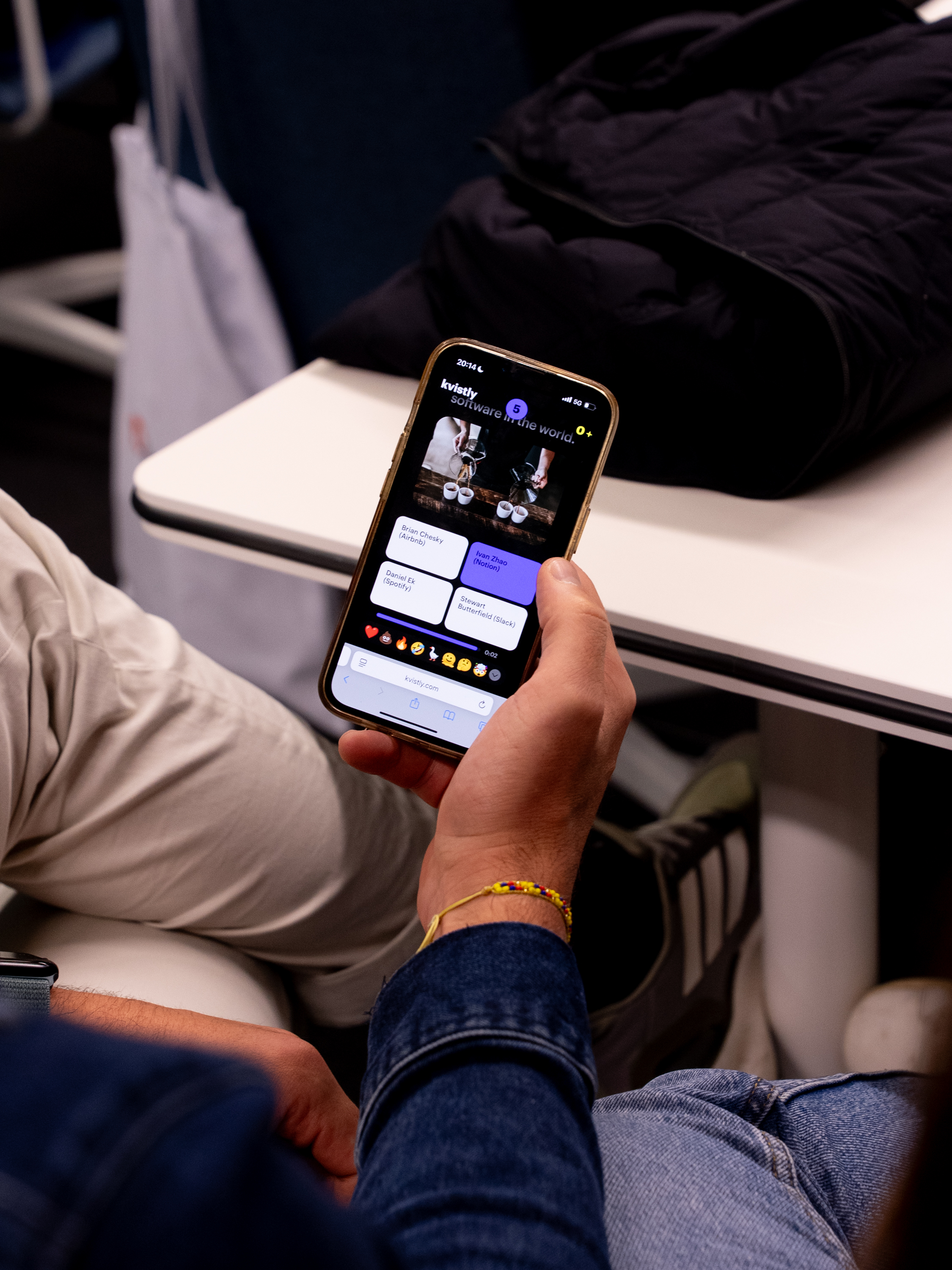
Setup is fast. A first session can be running in under five minutes: upload your training material, generate questions, share the link. The AI handles question creation well, the output is context-specific and covers the right details rather than generating generic filler.
The live session is where the product earns its reputation. In distributed teams that have historically struggled with low participation in training, the betting mechanic changes the dynamic immediately. People who usually multitask through sessions start competing to climb the leaderboard. Participants who tend to be quiet in traditional meetings engage when there’s a game structure around the content.
This matters especially in remote setups. Without the energy of a physical room, attention drops quickly in standard training formats. Kvistly keeps people involved longer than you’d expect, and the 95% of attendees who ask to repeat it is a metric that speaks for itself.
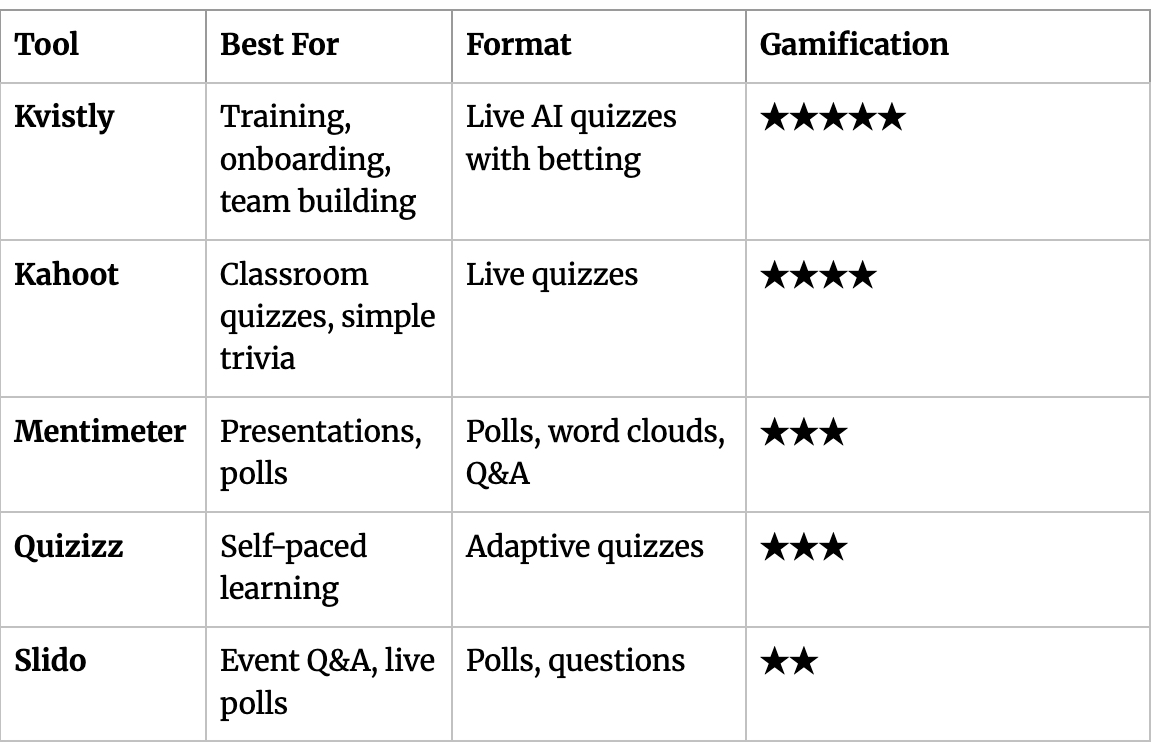
Kahoot and Mentimeter are both solid in their lanes, Kahoot for simple trivia-style sessions, Mentimeter for adding interactivity to presentations. Where Kvistly is different is the combination: AI content creation, live competition with real stakes, and analytics in a single flow. You don’t need to build questions manually, you don’t need a separate tool to track results, and the session format itself creates a level of energy that basic quiz tools don’t.
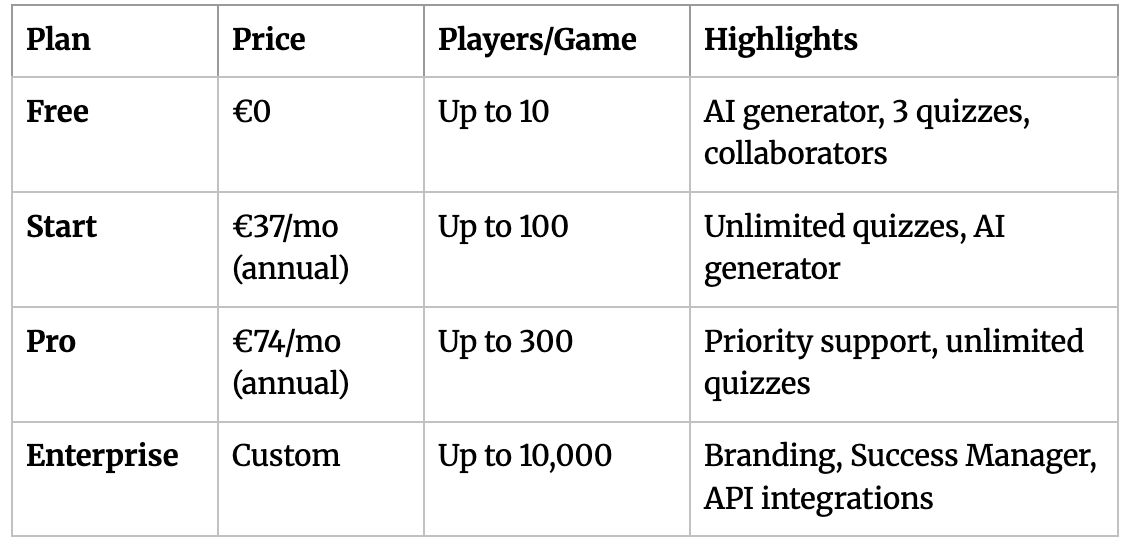
Public school teachers get full permanent access at no cost. The free tier is enough to run real sessions and see how your team responds before committing to a paid plan.
Kvistly is built for one thing: making sure that when your team gathers to learn something, they actually learn it, and enjoy the process enough to want to do it again.
For training, onboarding, and team building, it’s the most effective format available in 2026. The knowledge retention improves because people are actively engaged, not passively watching. The sessions feel different because there are real stakes. And the results show up in the numbers: 95% of participants ask to repeat it.
If those are the sessions you’re running, Kvistly is worth trying before your next one.

Kvistly is an AI-powered live quiz platform for teams and classrooms. It’s designed to make training sessions, onboarding, and team building events genuinely interactive, using live competition and a credit-based betting mechanic to keep participants actively engaged throughout.
No. Kvistly is a knowledge and participation tool. It’s designed to make training, onboarding, and team building sessions genuinely engaging through live AI-powered quizzes and competitive gamification, not to collect feedback or measure workplace sentiment.
Most users have a session live within five minutes of signing up. You upload your training material or enter a topic, the AI generates questions, and you share a link or QR code. No complex setup, no IT involvement required.
Yes, and it’s particularly effective there. Participants join from any device via link or QR code. The live competition format creates the kind of energy that typically requires a physical room, which is why it tends to outperform standard training formats in distributed team settings.
Each player starts with 2 credits and receives 1 credit before each question. Before answering, they wager some or all of their credits based on their confidence. A correct answer earns them what they bet. A wrong answer costs them. The leaderboard tracks credits, accuracy, and speed, so sessions stay competitive throughout.
You can upload documents, paste text, or drop in a link. The AI extracts context and generates questions with four answer options. It works well for product documentation, sales playbooks, onboarding materials, compliance content, and training decks.
There’s a free tier that lets you run sessions with up to 10 players and 3 quizzes, enough to test it properly with your team. Paid plans start at €37/month. Public school teachers get permanent full access at no cost.