
Last updated: October 2026
Looking for the best AI tools for HR? This guide compares 12 tools across three jobs HR teams actually need help with: engaging and training employees, hiring, and running day-to-day HR operations. For each one you get what it does, who it is for, and what it costs.
Kvistly, Mentimeter, Slido and Synk have free plans. Most recruiting tools and HR systems are sold on annual contracts or custom quotes.
Not all AI tools for HR are created equal. Some are built for enterprise teams with large budgets, others work well for startups and small HR teams. We looked at four things:
| Tool | Category | Best for | Free plan | Starting price |
|---|---|---|---|---|
| Kvistly | Engagement and training | AI-generated live quizzes for onboarding, training and team events | Yes | €19/month (€15/month billed yearly) |
| CultureMonkey | Engagement | Employee listening and surveys across locations | – | Custom pricing |
| Mentimeter | Engagement | Live polls during presentations | Yes | From about $12/month, billed yearly |
| Slido | Engagement | Q&A and polls for large meetings | Yes | From $17.50/month, billed yearly |
| HireVue | Recruiting | Structured video interviews at scale | – | On request |
| Eightfold AI | Recruiting | Skills-based hiring and internal mobility | – | On request |
| Fetcher | Recruiting | Sourcing and outreach to passive candidates | No | From $115/month |
| Leena AI | HR operations | Answering employee HR questions 24/7 | – | On request |
| HappyRobot | HR operations | High-volume voice, email and chat workflows | – | On request |
| Synk | HR operations | Syncing app access when people join, move or leave | Yes | $1/user/month |
| Lattice | Performance | Reviews, goals and feedback | No | Modules from $4/seat/month, billed yearly |
| BambooHR | Core HR (HRIS) | All-in-one HR system for small businesses | – | On request |
HR is a broad field, so the tools are grouped into three categories: employee engagement and training, recruiting, and HR operations.
Engagement directly affects employee retention and performance. The problem is scale: you cannot run one-on-one conversations with everyone every week. The tools below help you either create engagement in the moment (live sessions, training, events) or measure it over time (surveys and listening).

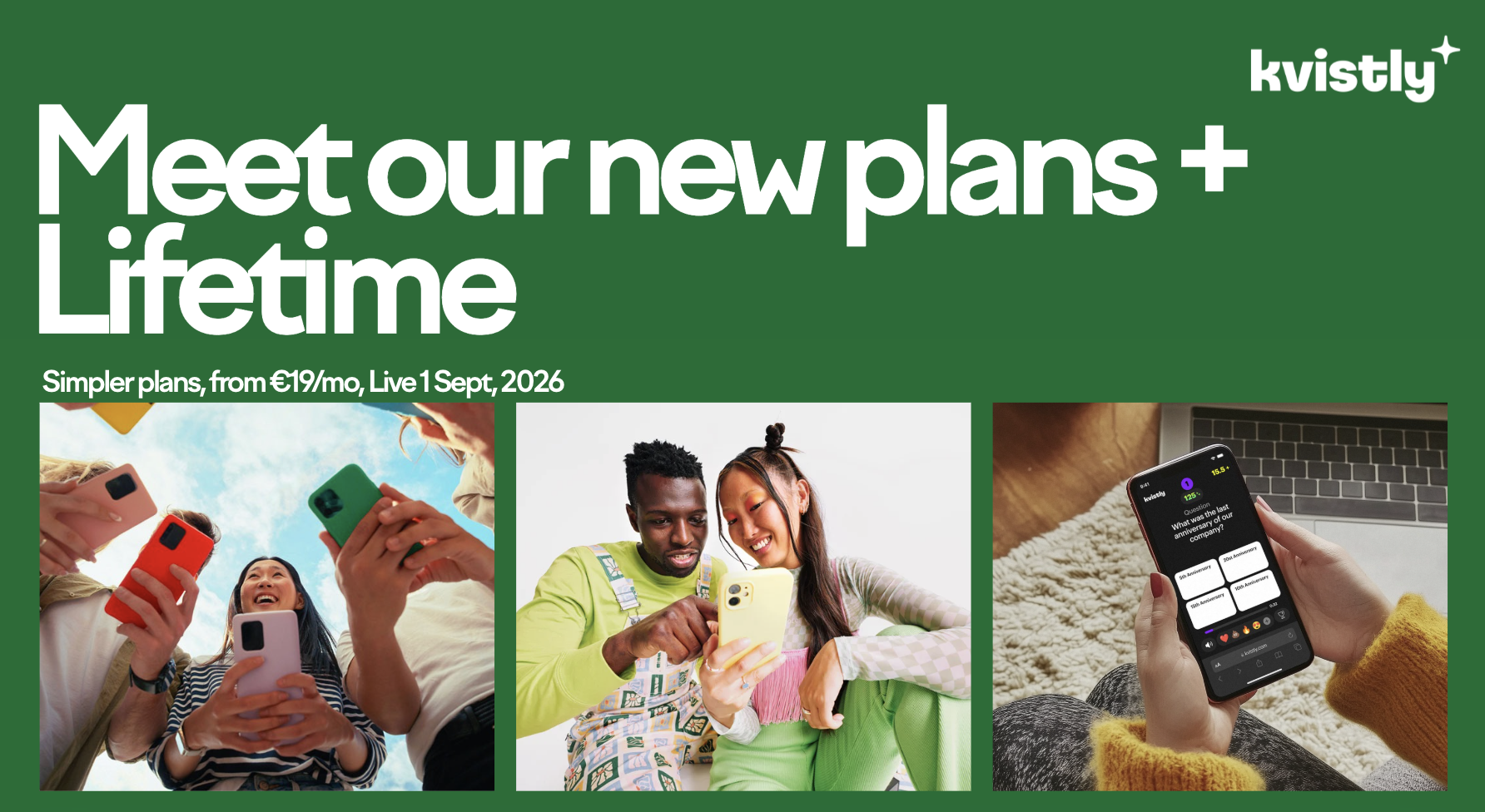
Kvistly is an AI quiz platform for HR and L&D teams. You type a topic, or upload your own material (a file, text or a link), and the AI writes the questions for you. Participants join from their phones with a link or QR code, with no app to download.
What makes it different from a standard quiz tool is the bidding mechanic: before each question, players bet credits on how confident they are. That keeps people thinking instead of guessing, and a live leaderboard keeps the room competitive until the last question.
HR teams use Kvistly for onboarding knowledge checks, training refreshers, all-hands meetings and team-building games for remote teams.
See all plans on the Kvistly pricing page.
Best for: HR and L&D teams that want training, onboarding and team events people actually participate in.
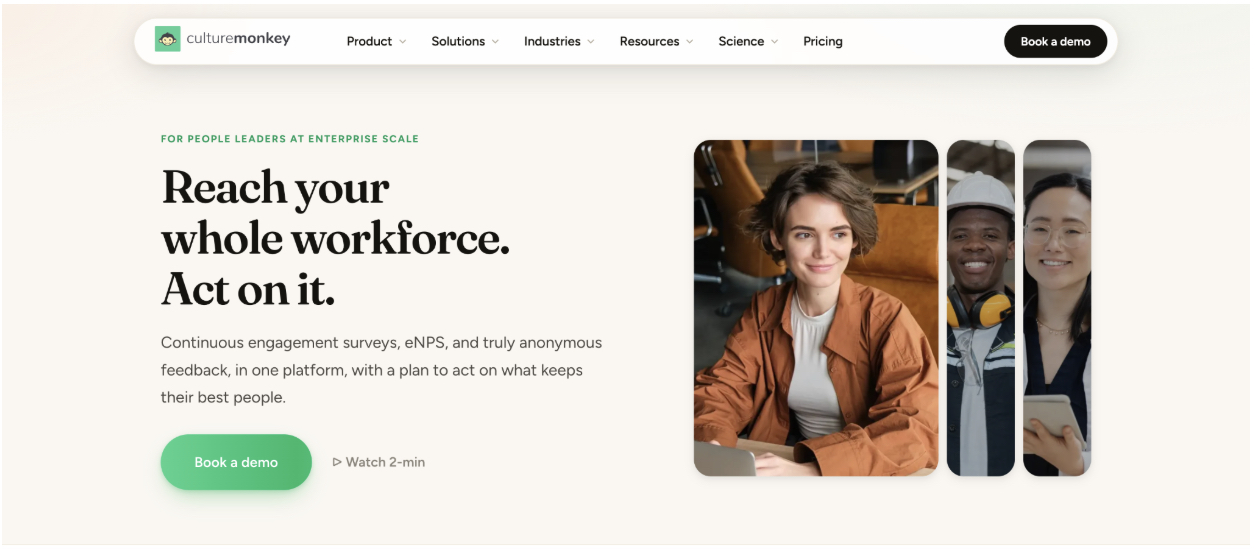
CultureMonkey is an employee engagement platform that helps organizations understand workforce sentiment and improve the employee experience across locations, roles and employment stages. It gives HR teams a structured way to gather honest feedback, spot emerging concerns and turn insights into action.
For global HR teams, employee listening is no longer limited to annual surveys or office-based staff. CultureMonkey reaches distributed and frontline workforces through accessible channels, and multilingual support helps organizations collect consistent feedback across regions. Managers get clear insights so they can own improvements.
One standout advantage: CultureMonkey combines enterprise-wide listening with confidential reporting, manager accountability and ongoing action tracking in one platform.
Pricing: Custom pricing based on organization size, headcount and requirements.
Best for: Enterprise HR teams that need consistent employee listening across global, distributed, multilingual and frontline workforces.
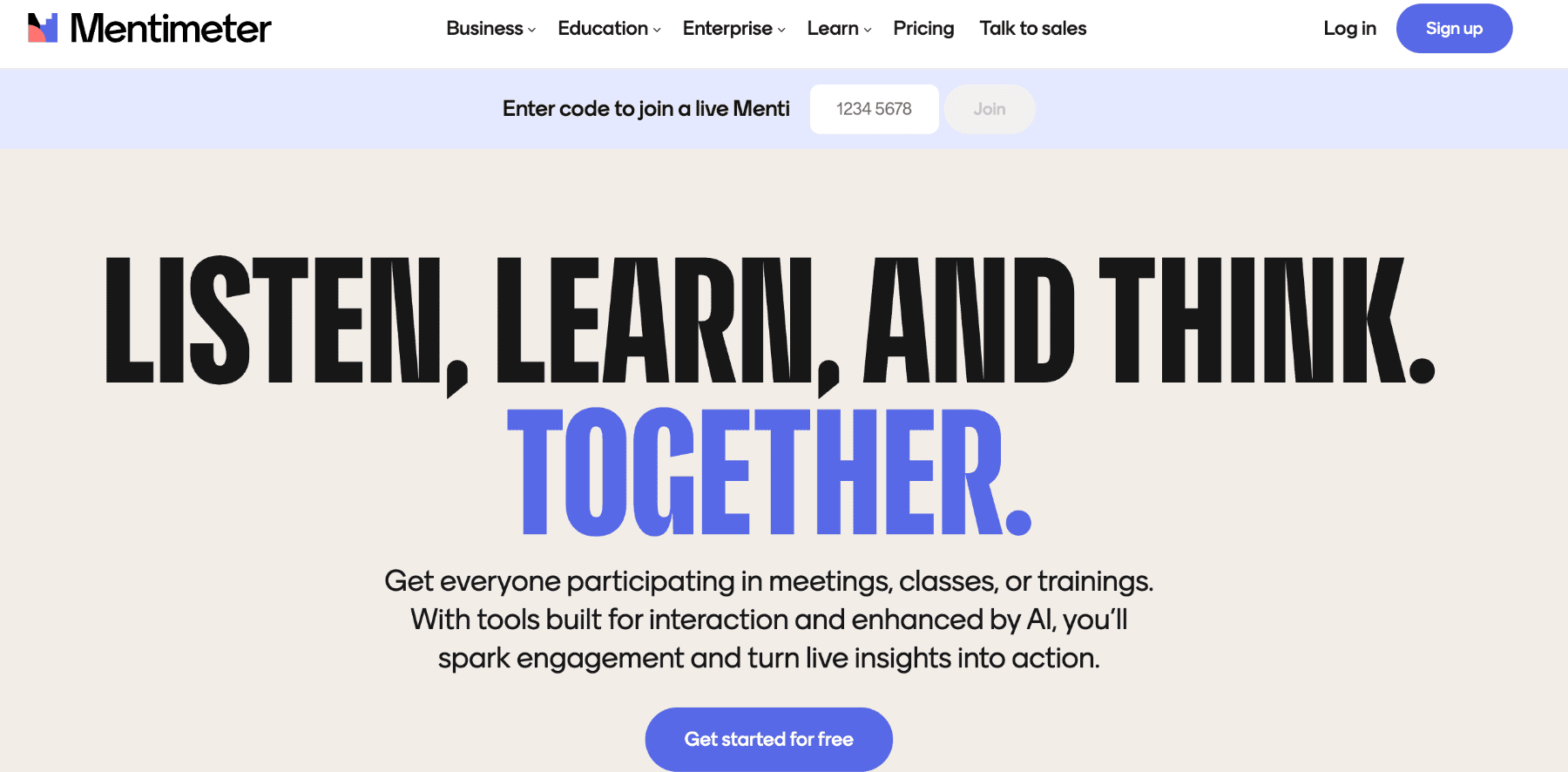
Mentimeter turns presentations into two-way conversations. During a meeting or workshop, employees answer polls, submit questions and add to word clouds from their phones, and results appear on screen instantly. Its AI features help you build interactive slides faster.
Pricing: Free plan available. Paid plans start at about $12/month, billed yearly.
Best for: Town halls, workshops and presentations with light audience interaction. Comparing options? See our list of Mentimeter alternatives.

Slido is built for meetings and events with a large audience. Its standout feature is anonymous Q&A: employees can ask leadership anything, and upvotes push the most important questions to the top. That creates psychological safety and surfaces feedback you would not hear otherwise.
Pricing: Free Basic plan. Paid plans start at $17.50/month, billed yearly.
Best for: Company-wide meetings and leadership communication. See also our Slido alternatives.
AI is helping HR teams screen candidates faster, reduce inconsistent evaluations and find talent they would otherwise miss. For small HR teams, these tools close part of the gap with larger competitors that have bigger recruiting budgets.

HireVue combines on-demand video interviews with structured, AI-supported assessments. Candidates record answers to the same questions, so every applicant is evaluated against the same criteria instead of 20 interviewers applying 20 different standards. It is a big time-saver for companies hiring for the same role repeatedly.
Pricing: On request.
Best for: Companies running high-volume, structured interviews.

Eightfold AI helps companies hire for skills and potential, not just resumes and pedigree. Its AI analyzes career paths to understand how skills develop, then matches people to roles they can do today and roles they could grow into. It also surfaces internal candidates for open roles, which supports mobility and retention.
Pricing: On request.
Best for: Mid-size and enterprise companies committed to skills-based hiring.

Fetcher automates the most time-consuming part of recruiting: finding and contacting passive candidates. You describe the profile you need, Fetcher searches for matches and sends personalized outreach sequences, and interested candidates are handed to your team.
Pricing: No free plan. Plans start at $115/month for self-serve, with higher tiers for larger sourcing volumes.
Best for: Hard-to-fill roles and passive candidate outreach.
HR teams spend too much time answering the same questions and handling admin. The tools in this category take that work off the team so it can focus on strategic projects.

Leena AI gives employees AI agents they can ask HR questions 24/7: how to submit expenses, what the parental leave policy is, when open enrollment starts. It connects to your HR systems and policy documents, so HR only steps in for cases that need human judgment.
Pricing: On request.
Best for: Automating the HR helpdesk.

HappyRobot takes the AI assistant concept further with AI workers that do not just answer questions: they handle entire operational workflows over voice, email and chat. For HR teams buried in repetitive, high-volume tasks like screening callbacks, benefits verification or candidate outreach, these agents pick up the load without adding headcount.
What sets it apart is the focus on execution rather than chat. The AI workers follow structured workflows, escalate edge cases to humans and run 24/7, which suits larger or fast-scaling teams. If you are weighing the bigger players in this space, compare the leading AI agent platforms before you commit.
Best for: Larger or fast-scaling teams automating high-volume HR operations.

Synk is a SaaS identity governance platform that removes the manual work of managing user accounts across your company tools. When someone joins, moves teams or leaves, Synk syncs their access across connected platforms, from Google and Slack to Jira, Asana, BambooHR and more.
For HR, that means onboarding and offboarding stop being a manual, error-prone process. You update one system and everything else follows, with no chasing IT to revoke access or add a new hire to the right Slack channels. Synk also gives you SCIM-like provisioning without upgrading every SaaS tool to its enterprise plan.
Pricing: Free plan available (up to 3 groups and 100 users). Pro starts at $1/user/month.
Best for: HR and IT teams that want to automate onboarding, offboarding and access governance.

Lattice is a people platform for performance reviews, goals and engagement surveys. Its AI features help managers summarize feedback and write better reviews, turning the annual review from a checkbox into an ongoing conversation.
Pricing: No free plan. Modules start at about $4 per seat/month, billed yearly, and bundles cost more.
Best for: Running performance reviews and continuous feedback.

BambooHR is not an AI-first tool, but it earns its place as the core HR system many small businesses run on, and it keeps adding AI features on top. It covers employee records, time off, hiring, onboarding and reporting in one place, which makes it a strong base to connect the specialized tools above to.
Pricing: On request.
Best for: Small and mid-size businesses that need one system for core HR.
No single tool does everything well. The best approach is to combine tools that are strong in different areas.
If hiring is the bottleneck, start with recruiting tools. If engagement or training is the issue, start there. Do not try to solve everything at once.
A 20-person startup needs something different from a 2,000-person company. Small teams usually do better with an all-in-one HRIS plus one or two focused tools, while larger teams benefit from specialized tools in each category.
HR data is sensitive. Ask where data is stored, whether the vendor is GDPR compliant, and whether the tool connects to your HRIS, Slack or Microsoft Teams.
Kvistly, Mentimeter, Slido and Synk all have free plans, so you can test them with a real team before you commit budget.
It depends on the job. Kvistly is the best choice for interactive training, onboarding and team engagement. HireVue, Eightfold AI and Fetcher lead in recruiting. Leena AI is strong for answering employee HR questions, Lattice for performance management, and BambooHR as a core HR system for small businesses.
For recruiting, HireVue is best for structured video interviews, Eightfold AI for skills-based hiring and internal mobility, and Fetcher for sourcing passive candidates. Pair them with an applicant tracking system or an HRIS like BambooHR.
Yes. Kvistly, Mentimeter and Slido offer free plans for engagement and live sessions, and Synk has a free plan for small teams managing app access. Most recruiting tools and HR systems are paid only.
It depends on whether you want to measure engagement or create it. To measure it, use a listening tool like CultureMonkey or Lattice engagement surveys. To create it in training sessions, onboarding and team events, use an interactive tool like Kvistly, Mentimeter or Slido.
Look for AI that does real work, integrations with the systems you already use, clear data privacy and GDPR compliance, a short rollout time, and transparent pricing. Test with a small team before rolling out company-wide.
No. AI tools take over repetitive work like answering common questions, screening applications and creating training content. Decisions about people, culture and sensitive cases still need human judgment.